
While 8-year-olds run and teenagers drag and toddlers dawdle, it is the curious yet cautious 5-year-olds who have the biggest day of all. For everyone else, this is the first day back to school. For a brand new kindergartener, this is the first day of school!
For some families this transition is as easy as 1, 2, buckle-my-shoe. Yet for many more, the first day of school brings a new buzz-term into the lives of kindergarten parents: SEPARATION ANXIETY.
Separation Anxiety is a form of anxiety experienced by a young child and caused by separation from a caretaker or familiar surroundings. Sure, you've heard this before. In fact, you probably experienced it in preschool and at grandma's and maybe even at a play date or two. But this separation anxiety is an entirely different breed. So for you, I present:
5 Tips for Surviving First Day Separation Anxiety:
 1. Remember that it is not just the kid who experiences separation anxiety:
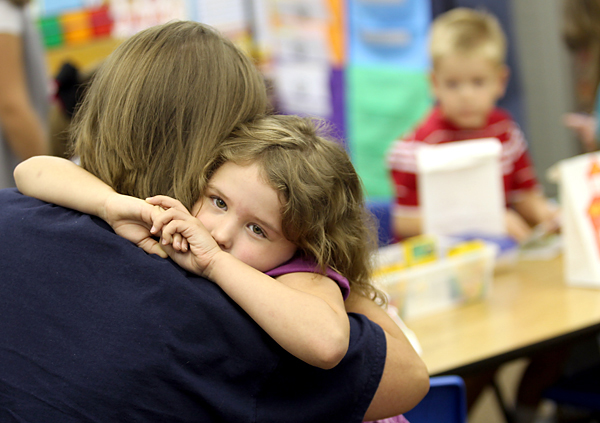
It is common sense among educators to know that when anxiety exists in a child, it often exists in a parent too. Not to be confused with the idea that parents are the cause of a child's anxiety, parental separation anxiety is rather a form of empathy, a testament to the depth of your connection to your child. After all, your qualms about leaving your child are instinctual. Biology's way of ensuring that you will not abandon your child to the wilds of the world. So, even though you, the rational adult knows that leaving your 5-year-old in kindergarten is not the same as abandoning your baby in the woods, it can feel exactly like that, and that is OK. In fact, it is normal. But before you run for the door consider this:
2. Your child's teacher is your ally:
Luckily for you, there is another rational adult in this equation: your kindergarten teacher. Though teachers come to you with a variety of experience levels, chances are that even one year of teaching allowed them to sample 25-35 different flavors of separation anxiety (compared to a parent with one or two children who has only tried butter pecan with tantrums on top). Plus, your child's teacher, though empathetic and compassionate, is not as inextricably linked to your child as you are. That is all to say, your child's teacher is able to be exactly what you need: someone who can think rationally with empathy about the situation at hand. If you do one thing on the first day of school, show your child that you trust their teacher by using that parent/teacher alliance in your favor and...
3. ASK FOR HELP!
I cannot reiterate this point enough. When your child's pencil breaks, when they fall down, when they are confused, sad, or in doubt, the one thing you want them to be able to do is ask for help. So, when you the parent, are faced with the moment of separation, ask the teacher for help. Not only does this give you the help you need and deserve, but it also provides a model for your child that asking for help is not only OK, it is the way to get things done.
4. Have a plan:
You would not walk into your first day of work without at least some idea of what you are doing, would you? Then of course, on your child's first day of school you should have an itemized, minute-by-minute itinerary of what they are doing that day. JUST KIDDING. But seriously, have a plan of action for the moment of separation. You want to develop a goodbye ritual because kids love routine. A small kiss on the cheek, a hug (*Note: one hug will do, because 10 will turn into 20 and 20 will turn into tears) and a cheerful reminder: "I will see you at 3pm at the front gate!" or "I will see you at home for dinner with me, dad, and your sister!" or "I will see you when I pick you up from grandma's at 4!" A quick "I love you" wouldn't hurt either. Whatever you choose, just make sure to review it with your child the night before and the morning of the first day. Then high five. Or fist bump. Or whatever you two do.
5. Leave before the first bell:
Remember the pressure you felt to get to class when you heard the bell in the morning? That bell, like an alarm clock, means "IT'S TIME" in a major way, and when it sounds, the adrenaline spikes. This is exactly what you want to avoid at goodbye time. Children and adults alike have an inherent sense of drama, and when the bell rings, it might as well mean 'Action! Let the water works begin!' Better to have a quiet goodbye before the bell tolls in a safe location where the teacher is nearby (I always encourage parents to use the door of my classroom) and then allow your child to join his or her peers in peace.
 Plus, by the time you pick them up, they may very well be crying again - and this time because they don't want to leave.

No comments:
Post a Comment